The problem
Anywhere the PA loses
A PA is built to carry announcements across a space. It was never built to tell the fan in row 40 what just happened at turn four.
The person who actually showed up gets caught between two systems. The PA loses to distance, acoustics, crowd noise, and the fact that one volume cannot suit everyone in the building. The broadcast has the commentary, detail and language—but the delay makes it useless for following the action in front of you.
That is the gap LiveCastNow fills: the immediacy of being there, with the listening experience of a broadcast.
Stadiums & arenas
Commentary and analysis for the seats, where the PA is built for announcements rather than storytelling.
Road races & marathons
A course is miles long. A PA is not. Spectators along the route hear the same call.
Golf & motorsport
Play spread across acres, with fans nowhere near a speaker or a screen.
Youth & college sport
Grandparents who cannot travel buy a pass and hear the game called live.
Overflow & watch parties
Concourse, beer garden, campground and lot — all inside the same broadcast.
Fairgrounds & festivals
Multi-day events where the same channel earns across every date on the run.
The receiver’s in their pocket
No hardware to rent, distribute, charge, collect or maintain. No app to install. No login required. Fans scan a QR code on their ticket or seatback and they’re listening in time for the anthem—in a venue-branded experience they immediately recognize and trust.
What the fan sees
No app. No account. Your brand.
One scan, and this is the entire interface. Nothing to download, nothing to sign up for, and your name on the screen rather than ours.
Tonight’s event
- 🎧 Live commentary
- 🎧 Pit lane
- 🌎 Español
- 🌎 Français
Their language
Picked on the way in, not configured. The same announcer, translated as they speak.
Their volume
Set on the device already in their hand, through the earbuds or hearing devices they already wear.
Their choice of feed
Commentary, pit lane, a team channel — a fan follows the part of the event they actually came for.
Putting your own logo and colours on the listener screen is part of a BYOPA Pro subscription. Without it the listening page still works exactly the same way — scan, pick a channel, listen — it just carries BYOPA’s colours instead of yours.
The economics
Putting on the event isn’t cheap
The dates are booked. The staff’s onsite. The PA is installed, the commentary team is in the booth, and the gate opens whether you make another sale or not. Those costs are committed.
Ticket revenue is capped by the number of seats in the building. Everything you earn past that — concessions, merchandise, parking, hospitality — rides on how engaged the crowd is once they are inside.
A listening pass is a second transaction on an event you’re already running. And it gives fans more of the event—more to hear, more to follow, and more ways to be part of the excitement.
The buyers
Who buys a listening pass?
The fans already in your building who want more from the event—and a more engaged fan creates more opportunities for concessions, merchandise and other add-on purchases.
Fans in the venue
They paid to be there and row 40 still gets a PA echoing off the far grandstand. The pass gives them the commentary, the detail and the analysis the television audience has always had.
Your best customers
Season-ticket holders are already on file and already paying annually. Sell them single dates or bundle the whole season — the easiest sell you have.
Fans beyond the venue
Sold-out dates, away supporters, the campground, the overflow lot, and the people who were never coming through the gate at all. Demand does not stop at the capacity number.
Language and accessibility are not a fourth audience. They are reasons any of the three above buy: a listener picks their language when they open the link, sets their own volume, and listens through the earbuds or hearing devices they already wear. That reaches people an English-only PA never did — inside the building and outside it.
The math
Run the numbers
Move the sliders. This is arithmetic on numbers you supply — not a projection of what you will earn.
a season, after fees · $4,157 per event · 960 passes an event
On a $6 pass you keep $4.33. BYOPA takes $1.20 at the 20% rate for that price band, card processing takes $0.47 (2.9% + 30¢, charged on every pass). Gross before fees would be $115,200.
This is a calculator, not a forecast. Take-up rate is the number that decides everything and it is the one nobody can tell you in advance — it depends on your sport, your crowd, your pricing, how visibly you promote it and how good the audio actually is. The 8% default is a placeholder, not a benchmark, and we have no data to claim it is typical. Run one date at a low price, measure it, then put the real number in. Fees come off the published BYOPA rate sheet current at the time of writing, plus Stripe’s standard card processing; both can change, and your own Stripe rate may differ.
What they are buying · example raceday
One venue, many channels
An illustration:
Grandstand · paddock · at home
Live commentary
The call of the race, the way the broadcast audience gets it. Running order, gaps, strategy, who just went off at turn four — all from the announcer voices your fans already know, heard live as it happens. It turns every seat into the best seat for following the race — and creates an experience worth paying for.
Sell some, give some
Officials and staff channels stay internal. Announcer and team channels become the paid pass. Same setup, one date.
Season or single
Offer listening passes by the event or for the entire season. Season-ticket holders are the natural first audience.
Race control, marshal and team communications are safety-critical and are frequently governed by your sanctioning body's rules on radio traffic. Treat anything on this page about official channels as an illustration of what is technically possible, not as a recommendation to move a safety system onto consumer data service. Operational comms should stay on the purpose-built radio system; this sits alongside it.
Three revenue effects
A channel is inventory
The pass is the obvious one. It is not the only one, and it may not be the biggest.
The pass itself
A fan pays for access to a feed, priced by the date or bundled across the season — on an event you were already running.
Sponsorship
“Tonight’s live commentary, presented by…” A channel is ad inventory you did not have last season, and the read is heard rather than skipped past on a board.
What an engaged fan spends
A fan following the detail stays longer and buys more — concessions, merchandise, add-ons. Harder to attribute than a pass sale, and not something anyone can size for you in advance.
Matchday
How it runs
-
Build the channels
One per feed — announcer, pit, officials, whatever the date actually has. Set which are free and which need a pass. Built once, reused every date on the calendar.
-
Put the code everywhere
Ticket, seatback, concourse signage, videoboard, programme. It opens in the browser fans already have — no app and no account to create in a queue.
-
Go live
Your commentary team talks into a mic. Fans hear the action in real time, in the language they choose, without the expected broadcast delay.
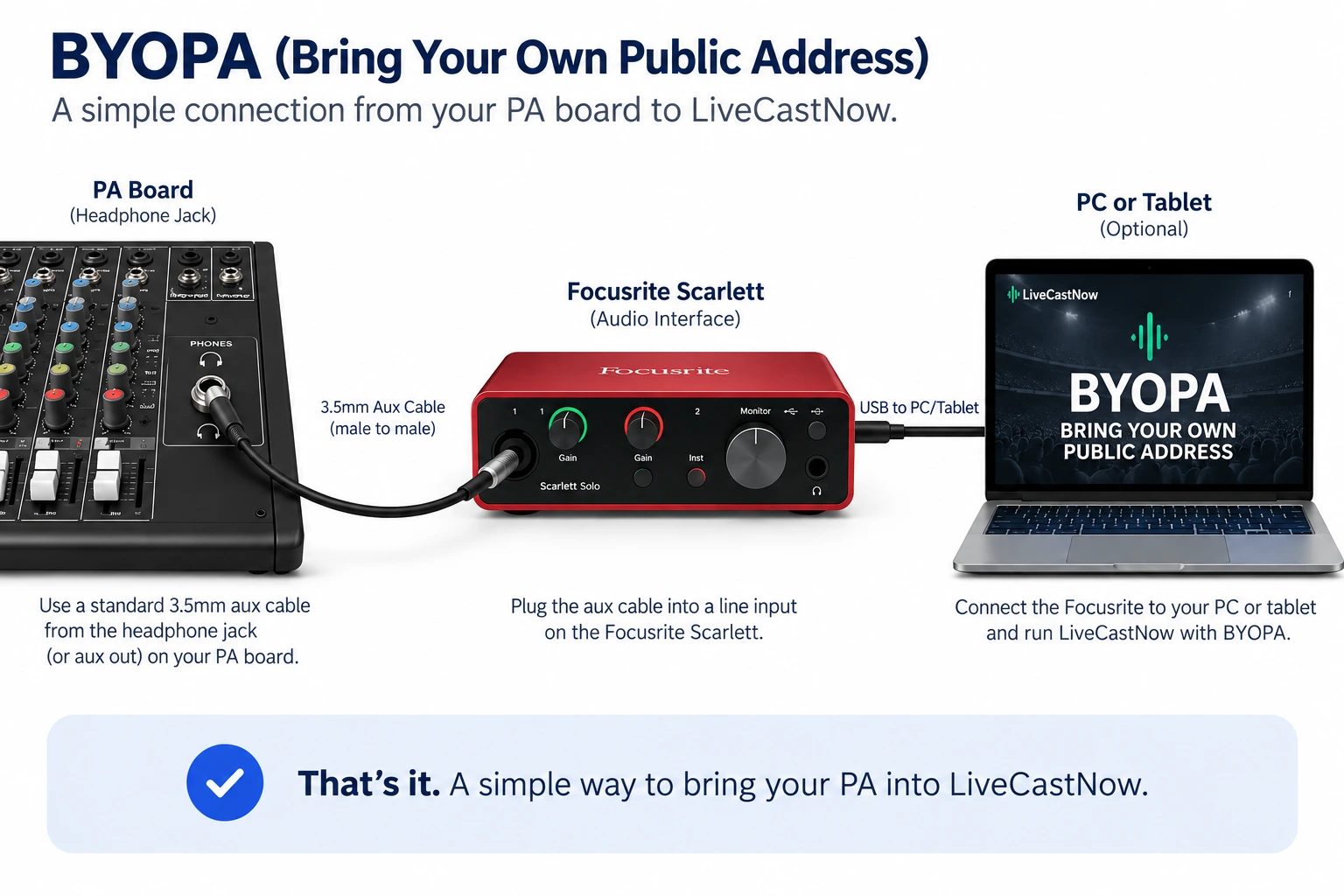
One thing to check early: live audio does not need much bandwidth, but dense crowds can still put a cellular network under pressure. A full house behaves differently from a walkthrough on a quiet Tuesday. Test under real event conditions before promoting a paid pass, and know what your venue Wi-Fi and cellular coverage can actually deliver at peak.
Try one date
Try it
Pick an event you already have scheduled. Build the channels, price a pass low, and see what take-up actually looks like at your venue.
Starting an account is free, and a trial can take free channels live. Selling passes needs a paid Starter plan or higher — a trial can build and save a paid event but cannot take it live or collect payment. Once the trial ends, a plan is needed to take anything live, free channels included.